menu
close
Home
About
Projects
Publications
Blog
The main means of providing access to the results of scientific research are considered. The study analyzes statistics that clearly demonstrate the main trends in the field of scientific communications on a global scale.
This scientific article discusses the topic of creation and keep up to date the internet portal of a network library, using the example of the Library for Natural Sciences of the Russian Academy of Sciences (LNS RAS).
The reasons for the inaccessibility of scientific publications for scientists are analysed, a description of the process of formation of the idea of open access is given, and an overview of the current state of affairs in publishing scientists' achievements in open access is given.
Neural networks have come to process huge amounts of information, extract its essence, compose a coherent text on their basis that cannot be distinguished from a human one, and conduct a conversation, taking context into account.
Neural networks have learned to process huge amounts of information, extract the essence from them, compose a coherent text on their basis that cannot be distinguished from a human one, and conduct a conversation taking into account the context.
The article describes the cloud corporate cataloguing system used in LNS RAS, also provides statistics on the borrowing of bibliographic records from this system by various research institutions.
This collection contains materials from the scientific and practical conference '50 Years for the Benefit of Russian Science', focusing on information and resource support for scientific activity in the context of digital transformation.
In the monograph, O.P. Neretin considers intellectual sovereignty to be an integral, complex concept comprising diverse legal, personnel, managerial, financial, scientific and technological instruments for supporting and developing the institution of intellectual property.
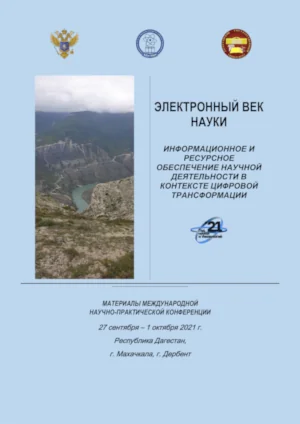
This collection contains materials from the International Scientific and Practical Conference, 'The Electronic Age of Science', focusing on information and resource support for scientific activity in the context of digital transformation.
The hypothesis for possibility to organize the promotion of certain information resources among library readers by analogy of search results in Internet search engines is substantiated. Some examples of experiments that influenced readers’ strategies for finding and reading documents are provided.
On 17 February 2018, Vladimir Putin signed a resolution in response to a letter from Russian presidential aide Igor Shchegolev containing four points. The implementation of these points should improve the functioning of the National Electronic Library (NEL).
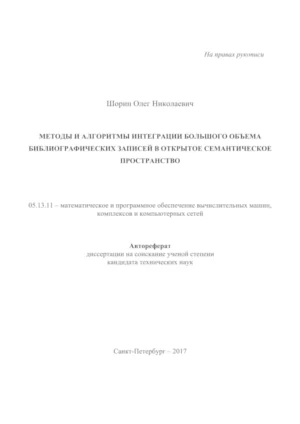
Abstract of a dissertation submitted for the degree of Candidate of Computer Science in the speciality of Mathematical and Software Support for Computers, Complexes, and Computer Networks (05.13.11).
Interview with Oleg Shoriny, one of the conference organisers and Deputy Director of the National Library of Russia for Informatisation
In the course of implementation of the National electronic library project there is an issue of consolidation of electronic catalogs of various libraries from all over the country.
In order to automate the processing of data collected in the National Electronic Library, these data need to be published in an open electronic format that permits for interrelations between different entities to be taken into account.
The present paper discusses the use of a function belonging to the locality-sensitive hashing family, with additional optimisations, for the identification of duplicate bibliographic records.
The National Electronic Library (NEL) project has been under development since 2004. Initially, only two libraries participated in the project: the National Library of Russia and the Russian State Library.