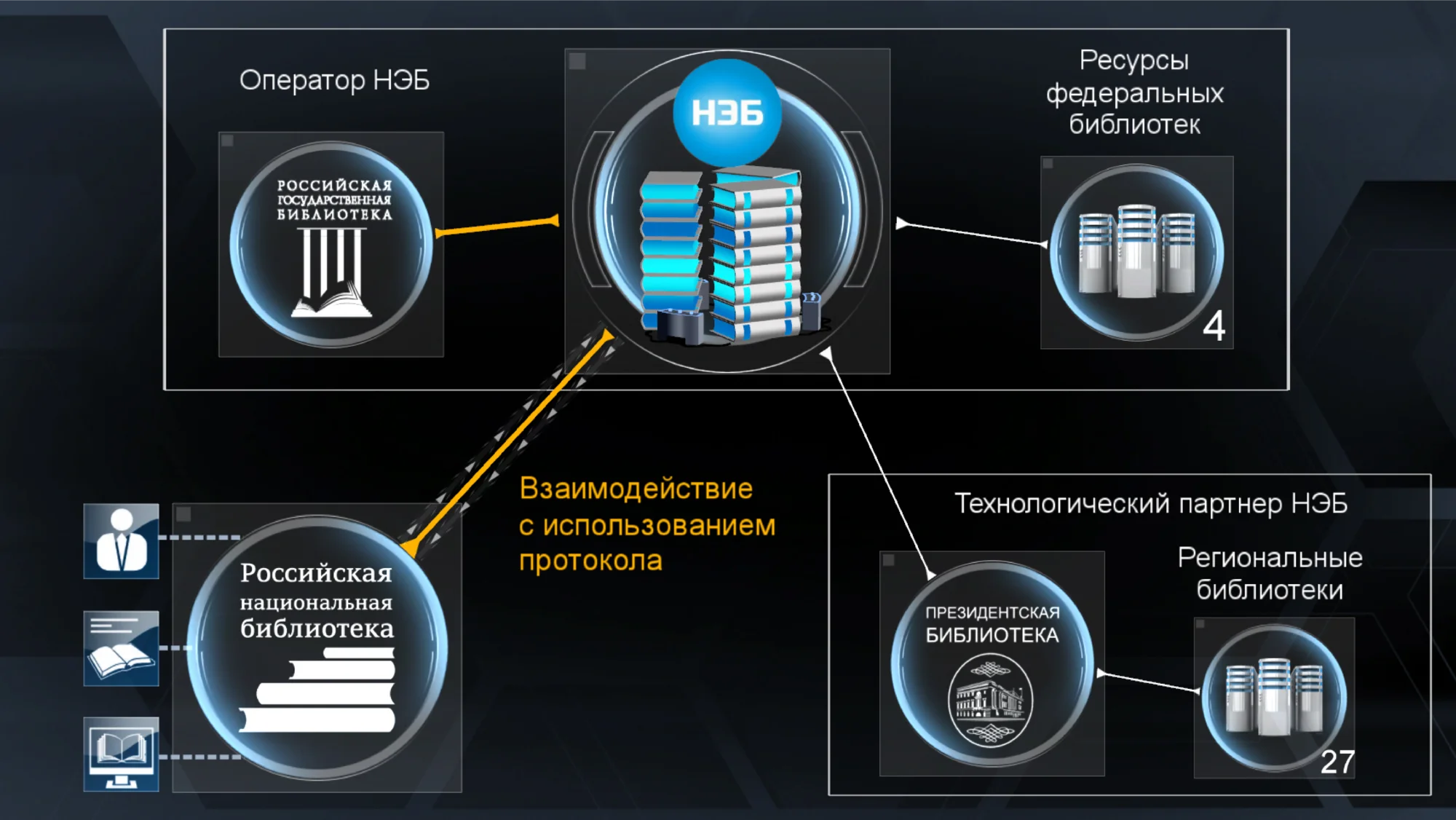
National Electronic Library (NEL)
The National Electronic Library is a national-scale government digital platform that brings together libraries, publishers, and content providers into a unified knowledge ecosystem.
The NEL catalog contains more than 50 million records, with resources available 24/7 through a network of 6,000+ libraries.
My Role: Architect of NEL Integration Framework and Scaling Model
I joined the project at a time when NEL required a new scaling model: a unified framework for electronic document exchange across dozens of organizations with different infrastructures, legal regimes, and security requirements.
My Key Contribution
Creation of the Core Integration Protocol (2015)
In 2015, I designed the first distributed integration protocol between the central portal and NEL participants. It enabled:
- a single portal for end users;
- parallel search across millions of documents;
- page-level document delivery without transferring full files;
- compliance with licensing restrictions when accessing content;
- detailed usage analytics recognized within official state performance metrics for libraries.
This protocol became the foundation of NEL’s hybrid architecture — combining centralized and distributed approaches. The protocol specification is publicly available in the Vivaldi system documentation: https://help.vivaldi.ru/api/v3/.
Development of the Second Protocol Version: Distributed Rights Registry (2017)
As NEL expanded, it became clear that libraries and rights holders needed stronger control mechanisms. The second version of the interaction model, which I developed, enabled the ability to:
- move access decisions to the content owner’s side;
- verify user rights in real time;
- unify legal and technical restrictions;
- establish a distributed rights registry that was transparent and scalable.
This version removed key legal and technical barriers and enabled rapid onboarding of new participants without manual redesign of their infrastructure.
Development of the Third Protocol Version — Transition to Direct Royalty Payments
After 2018, NEL was tasked at the state level with transitioning to a system of direct payments to rights holders based on actual usage. The third version of the protocol, which I developed, enabled:
- introduce paid access packages;
- enable legally compliant monetization of individual documents;
- ensure complete transfer of reading and purchase data;
- create a unified integration interface for publishers, libraries, and NEL.
It transformed NEL into an open technology platform and allowed leading electronic library systems to integrate without changing their internal architecture.
As a result, onboarding new rights holders became significantly faster and more transparent, while the model gained a sustainable foundation for the digital content economy.
Creation of a Multi-Level Distributed Architecture
The solutions I developed enabled NEL to evolve from a simple “operator → participants” scheme into a multi-level model including:
- the central NEL portal;
- participants combining library and integration functions;
- commercial content providers;
- departmental libraries connected through a unified protocol.
This architecture remains in use today. It continues to serve as the foundation of Russia’s distributed digital infrastructure for scientific and cultural heritage, while also enabling further scaling of NEL without centralizing participant infrastructure.
For a more detailed overview of the project’s evolution, see my article "More Than Just the NEL":
CDTO Competencies Demonstrated by the Project
Strategic Thinking and Systems Engineering
The architecture I introduced proved to be vendor-neutral, resilient to growth, and highly scalable, ultimately becoming an industry standard.
Stakeholder Management
The project required coordination across:
- federal libraries;
- the Ministry of Culture and the Ministry of Education;
- the Presidential Administration;
- software development teams;
- dozens of rights holders.
I was able to align all stakeholders around a unified operating model.
Leadership and Influence
I had to consistently demonstrate the viability of the model to operators, decision-makers, and IT teams. The consistency of execution and technical integrity of the solutions helped position NEL as an industry benchmark.
Complex IT Program Delivery
I managed the full implementation lifecycle:
- architecture design;
- coordination with software developers;
- integration with the infrastructure of dozens of institutions;
- production rollout;
- scaling and continuous development.
Innovation and Results Orientation
The third protocol version became the first technological solution in Russia to enable:
- accounting for actual usage of digital works;
- building an economic model for direct payments to rights holders;
- scaling the system without changing participant architectures.
Project Scale
- 17+ years of NEL development, including key architectural phases under my leadership.
- Tens of millions of documents available through a unified interface.
- Thousands of libraries, publishers, and digital library systems connected through the platform.
- One of the largest distributed archives of scientific and educational literature in Russia.
- A national-level government initiative requiring highly reliable engineering solutions.
The project became one of the most significant digital transformation initiatives in the Russian library sector.
The solutions developed during my involvement continue to underpin the ongoing operation and future development of NEL.
Expert Publications Related to the Project
I also published an in-depth expert analysis covering NEL architecture, scaling models, access control systems, and future directions for platform development.