Vivaldi — Distributed Digital Library Platform
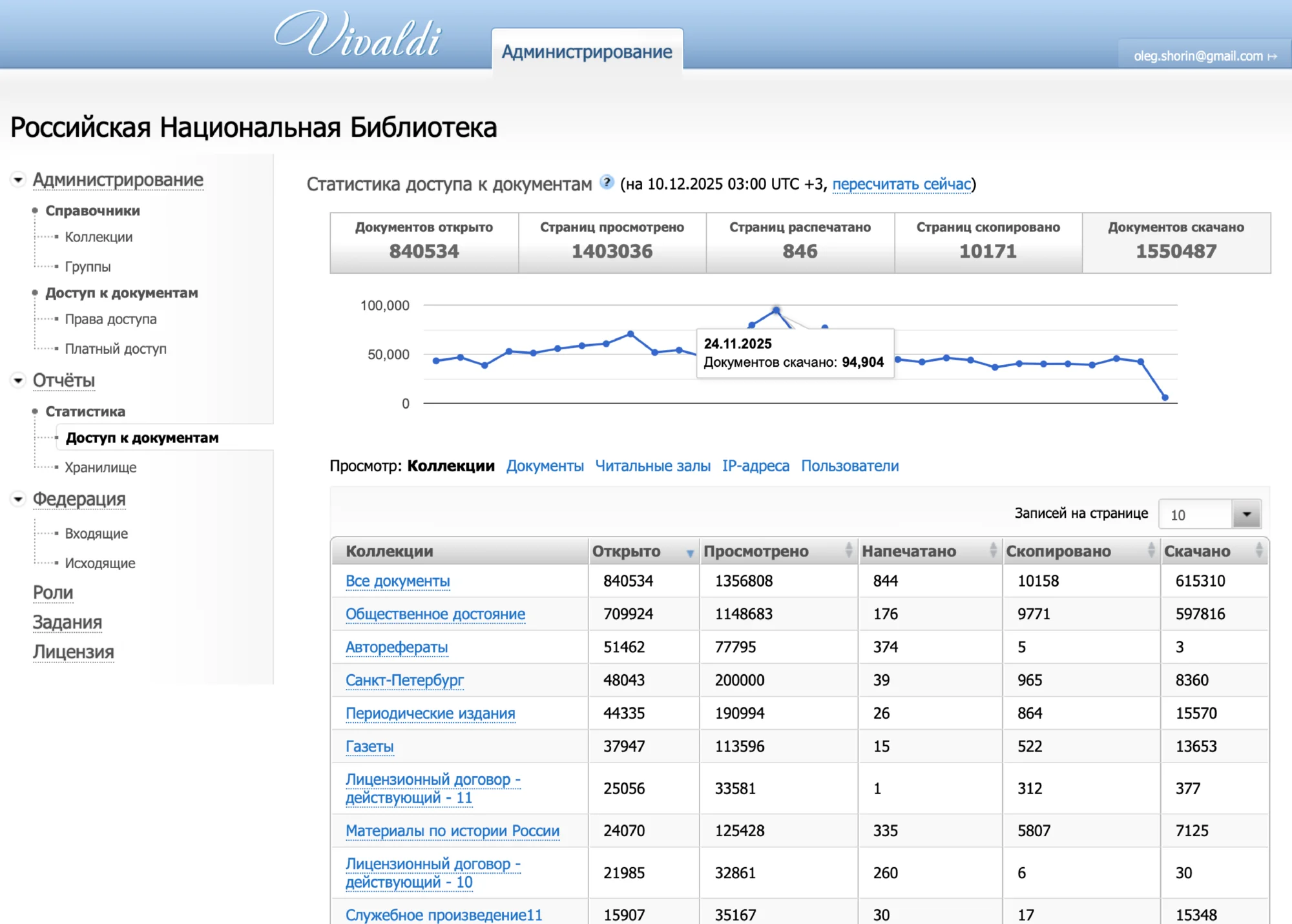
Vivaldi is one of the most technically advanced and large-scale projects I delivered as a CDTO and System Architect. It is a comprehensive platform that provides secure access to digital collections of major national libraries, universities and government institutions.
The core vision behind Vivaldi was to offer users fast and convenient access to digitized materials while ensuring a high level of copyright protection and the ability to scale the platform at a federal level.
Under my leadership, Vivaldi evolved from a narrow technical solution into a full-fledged ecosystem — spanning server infrastructure, content-protection mechanisms, client applications, administrative tools and large-scale content management workflows.
The platform was deployed across leading institutions, including the Russian State Library, the National Library of Russia, the Russian State Library for Young Adults, RGALI, SPbGIK, MGIK, Voronezh State University, Plekhanov University and several government agencies. This became possible thanks to a strong product strategy, a deeply thought-out technical architecture and a clear execution model.
Vivaldi remains in use today in several libraries — for example, in the National Library of Russia, where it powers access to over a million digitized books for hundreds of thousands of readers every day.
My own dissertation abstract is publicly accessible through Vivaldi:
https://vivaldi.nlr.ru/bd000350046/view/
My Role — Creator, Vision Owner and Chief Architect
Strategic Leadership
- Defined the long-term product vision and roadmap for the platform.
- Transformed Vivaldi from a narrow internal tool into a nationwide digital library system used by thousands of users across dozens of organizations.
- Established security, performance and quality standards that shaped the entire engineering process.
Architecture Ownership
- Designed the distributed architecture ensuring high availability and fault tolerance.
- Created the secure content-rendering pipeline that converts PDFs into protected images.
- Defined integration principles with catalogs, external systems and enterprise services.
Technical Leadership
- Built an engineering culture around quality, code reviews, DevOps practices and predictable delivery.
- Solved mission-critical challenges related to performance, scaling and security.
- Directed the development of the document-processing cluster, caching pipelines and high-load server components.
Team & Stakeholder Management
- Led negotiations with national libraries, universities and government agencies.
- Balanced legal, product and technical requirements in a complex stakeholder environment.
- Coordinated the work of distributed engineering, QA, analytics and support teams.
Key Achievements
- Built a scalable distributed architecture capable of handling thousands of concurrent reading sessions.
- Designed a unique security model: documents are rendered on the server and delivered as protected images.
- Integrated the platform with the country’s largest libraries — including the National Library of Russia and the Russian State Library.
- Delivered a full ecosystem of cross-platform client applications (Windows, macOS, Linux, iOS, Android).
- Developed an advanced admin console for libraries and rights-holders: content ingestion, permissions management, analytics.
- Implemented a flexible access-control model: organizations, roles, document types, geofencing, time-limited access, subscription tiers.
- Achieved high platform resilience through clusterization and horizontal scaling.
- Orchestrated engineering, QA, DevOps and operations to ensure long-term product stability.
- Shaped the strategic roadmap for Vivaldi as a national digital-library and virtual reading-room platform.
- Reduced infrastructure costs through architectural optimizations and efficient resource usage.
Technical Architecture Overview
Vivaldi was designed to operate under high load and strict copyright-protection requirements. The architecture consists of several major components:
1. Central Management Server
- User, organization and reading-room management.
- Routing requests to document-processing nodes.
- Access control (ACL + policy engine).
- Integration with external catalogs (Z39.50, REST, SOAP).
- Full event logging and analytics.
2. Document Processing Cluster
- On-the-fly PDF-to-image rendering.
- Watermarking and access-signature generation.
- Guarantee that original files are never exposed to the client.
- Page caching and intelligent prefetching.
- Horizontal scaling under peak load.
3. Secure Viewer (Client Applications)
- Displays protected page images.
- Restricts copying, printing and local saving.
- Optimized rendering for low-power devices and poor network conditions.
- Supports Windows, macOS, Linux, Android and iOS.
4. Access Control & Security Layer
- User roles: reader, staff, administrator.
- Access restrictions by document type.
- Geographic rules: on-premises, VPN, corporate network.
- Access models: free, subscription, paid bundles.
- Advanced policy engine with priority and fallback logic.
5. Administrative Panel
- Document ingestion and metadata management.
- Permission configuration and audits.
- Viewership analytics and collection reports.
- Management of organizations, branches and virtual reading rooms.
6. Integrations & External APIs
- Library protocols: Z39.50, SRU, REST.
- Authentication: LDAP, Active Directory, SSO.
- Corporate and government information systems.
7. High Availability & DevOps
- Horizontal scaling across nodes.
- Clustered document-processing servers.
- Load monitoring and health checks.
- CI/CD pipelines for client and server updates.
- Distributed logging and diagnostics.