National Electronic Library (NEL)
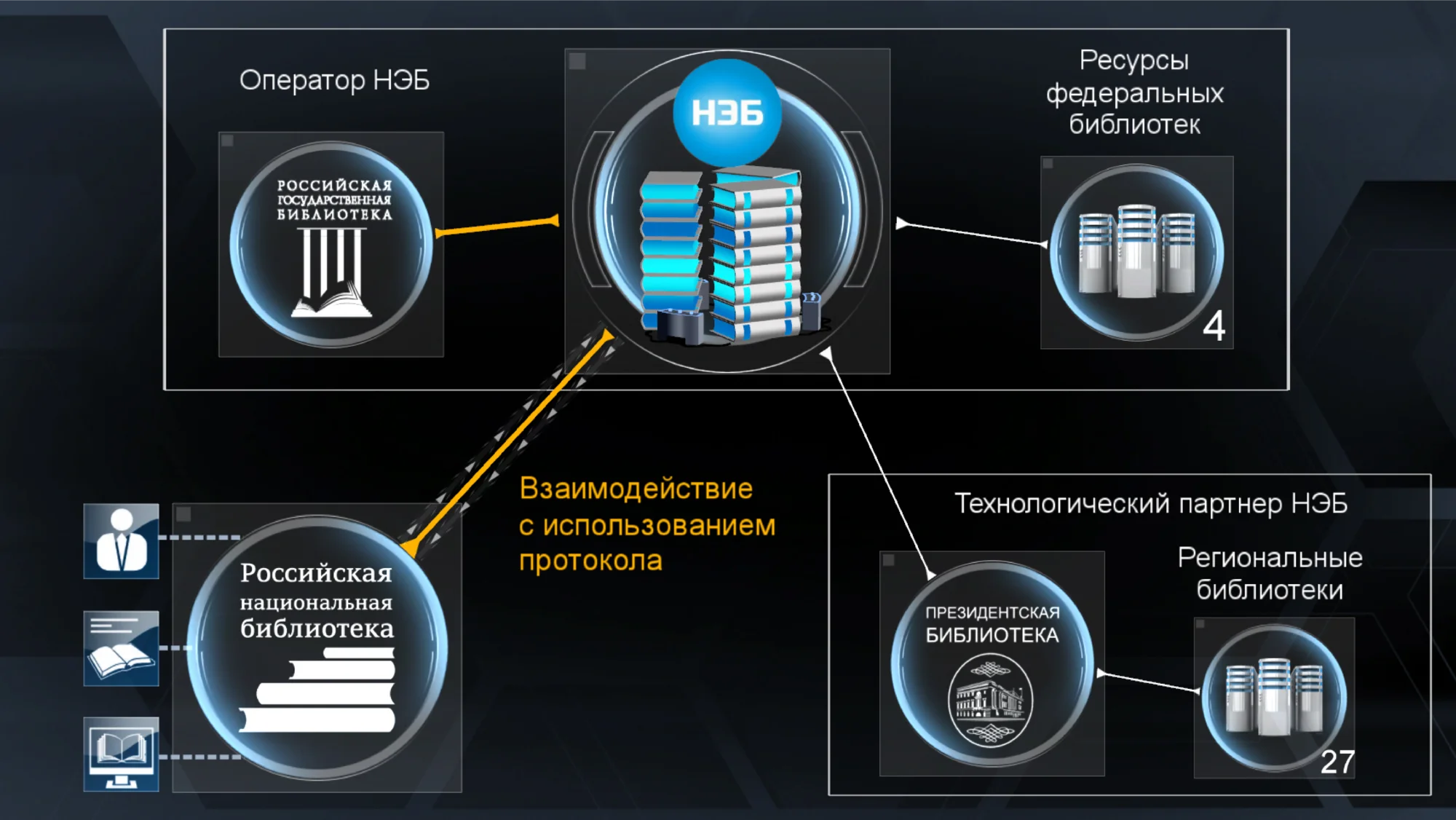
The National Electronic Library is a distributed digital ecosystem that connects federal, regional, and departmental libraries, academic publishers, and electronic library systems across Russia.
Today, the NEL catalogue contains over 50 million records, with access provided 24/7 through a nationwide network of more than 6,000 libraries.
My role: author of the technology protocol that shaped the architecture and evolution of Russia’s largest distributed library system
I joined the project at a pivotal moment, when the NEL faced a fundamental technological challenge: to create a unified mechanism for exchanging digital content between dozens of organizations, each with distinct infrastructures, legal constraints, and security requirements.
This is when the interaction architecture—now the foundation of the modern NEL—was conceived and implemented.
My key contributions
Designing the initial interaction protocol (2015)
In 2015, I developed the first protocol enabling distributed interaction between the central NEL portal and participating institutions. This protocol made it possible to:
- offer a single unified portal for readers;
- run parallel search across millions of records;
- serve document pages without transferring full files;
- ensure fully compliant access to licensed content;
- generate detailed usage analytics required for state reporting.
This protocol became the backbone of NEL’s hybrid architecture—both centralized and distributed.
A technical description of the protocol is available in the Vivaldi system documentation: https://help.vivaldi.ru/api/v3/.
Creating the second-generation protocol: a distributed rights registry (2017)
As the NEL grew, libraries and rights holders needed finer control over access. The second version of the protocol, which I designed, enabled:
- moving access-control decisions to the content holder’s side;
- real-time evaluation of user permissions;
- unification of legal and technical access rules;
- a distributed rights registry that is transparent and highly scalable.
This upgrade removed critical legal and technical barriers and unlocked large-scale onboarding of new participants.
The third-generation protocol — enabling direct payments to rights holders
After 2018, the NEL received a government mandate to introduce direct payments to rights holders based on actual usage.
The third version of the protocol, developed by me, introduced:
- paid access packages;
- legally compliant monetization of individual documents;
- full analytics on reading behavior and purchases;
- a unified technology interface for publishers, libraries, and the NEL.
This transformed the NEL into an open technology platform, allowing major commercial ELS providers to integrate without changing their internal systems.
Building a multi-layer distributed architecture
My architectural decisions enabled the transition from a simple “operator → participants” model to a multi-tier ecosystem:
- the central NEL portal,
- participants acting both as libraries and integrators,
- commercial content providers,
- departmental libraries connected through a unified protocol.
This model remains the backbone of the country’s distributed digital infrastructure for scientific and educational heritage.
More on the project’s evolution can be found in my article
“More Than Just the NEL”:
https://www.unkniga.ru/innovation/tehnology/8805-necht-bolshee-chem-prsto-neb.html
What this project demonstrates about me as a CDTO
Strategic thinking and systems engineering
The architecture I introduced turned out to be technology-agnostic, scalable, and resilient to rapid growth — and ultimately became an industry standard.
Working with diverse stakeholders
The project required coordinated effort across:
- federal libraries,
- the Ministry of Culture and the Ministry of Science and Higher Education,
- the Presidential Administration,
- software vendors,
- dozens of rights holders.
I was able to build a unified approach that satisfied all sides.
Leadership and the ability to influence
The first version of the protocol had to be defended “on the battlefield” — proving the viability of a distributed model to ministries, operators, and engineering teams.
Consistent work and architectural coherence allowed the NEL infrastructure to become a national-level standard.
Managing complex IT programs
I led the full delivery cycle:
- architectural design,
- coordination with developers,
- integration across dozens of organizations,
- production rollout,
- long-term scaling and evolution.
Innovation and results orientation
The third-generation protocol became the first technology in Russia capable of:
- tracking real usage of digital works,
- forming an economic model for direct payments,
- scaling without requiring architectural changes from participants.
Project scale
- 17+ years of NEL development, built on the architecture I created.
- Tens of millions of documents available through a single interface.
- Thousands of libraries, publishers, and ELS systems connected via the platform.
- The largest distributed repository of scientific and educational literature in Russia.
- A national-level government initiative requiring exceptional engineering reliability.
This project is one of the most significant digital transformations in the library sector in Russia.
And I am proud that the architecture and protocol I designed remain at the core of how the NEL operates and evolves today.